Business Growth

How Data-Driven Decision-Making Helps FMCG Companies Increase Profitability
Learn how FMCG companies can use business data to improve sales, manage inventory, reduce costs, and how InvexERP supports smarter

Business growth is often celebrated through higher revenue, new customers, expanded operations, and larger market share. However, many organizations don’t often stop to ask if their workforce can actually support the next stage of their growth.
The Nigerian Economic Summit Group’s 2026 Private Sector Outlook identifies talent and skills shortages as a significant business risk. The report also highlights talent management, cost efficiency and technological capability as critical to business performance.
This means that it is imperative for businesses to treat workforce planning as a business-growth strategy.
Workforce planning is the process of ensuring an organization has the right people, skills, structure, and capacity at the right time to execute its business strategy.
It goes beyond asking, “How many employees do we have?”
The better questions are:
Without answers to these questions, organizations can grow faster than their people systems can support.
Why Workforce Planning Matters for Growing Businesses due to the following reasons:
Opening new branches, entering new markets, increasing production, or launching new products all create additional workforce requirements.
A growing FMCG company, for example, may need more sales personnel, supply-chain expertise, production capacity, and supervisory leadership. The objective of workforce planning is capacity, not headcount.
Nigeria’s labour market contains a large and diverse workforce, but the availability of people does not automatically mean the availability of the specific capabilities businesses need.
Organizations therefore need to identify critical skills before they become urgent vacancies.
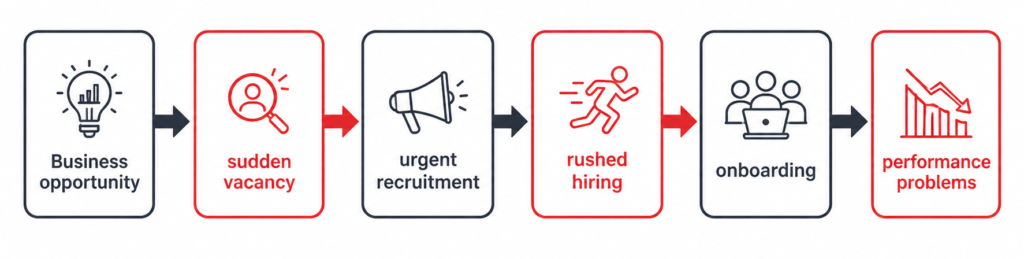
Reactive recruitment typically looks like this:
However, strategic workforce planning changes the sequence:
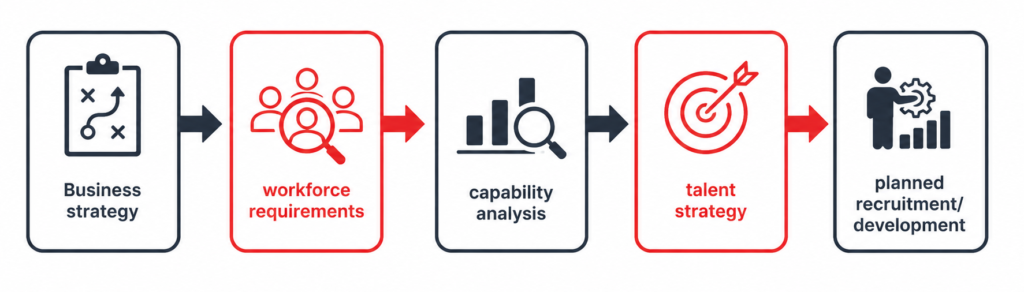
That difference can significantly improve hiring quality and workforce readiness.
To build a scalable workforce, you can follow these simple steps,
Business growth strategies are structured approaches organizations use to expand, increase revenue, and strengthen their competitive position over time.
You must identify your growth targets, new markets, operational changes, technology investments, and strategic priorities. Your workforce strategy should then translate those priorities into people and capability requirements.
Not every position carries the same strategic importance. Identify roles that directly influence revenue generation, customer experience, operations, innovation, compliance, leadership continuity, and business-critical processes
Then determine the capabilities required to perform those roles effectively.
Compare your current workforce capabilities with what the business will require in the future.
You may discover three different gaps:
Each of these gaps requires a different solution.
Not every capability needs to be developed internally. As an organization, you can:
This gives businesses greater flexibility as market conditions change.
A scalable workforce must also be resilient. The following questions can help you plan for such risks:
Workforce planning should therefore include succession planning, talent pipelines, and contingency workforce strategies.
A growing business needs a better-planned workforce, not necessarily a bigger one. The organizations that scale successfully understand that people capacity must grow alongside business ambition. They anticipate capability requirements, develop internal talent, recruit strategically, and use flexible workforce models where appropriate.
Your goal must be to build a workforce capable of delivering tomorrow’s strategy, not run today’s business
If you need help building a workforce that can scale, Smart Partners Consulting Limited is at your service. We help FMCG & Hospitality organizations develop workforce strategies, recruit high-performing talent, and deploy flexible Recruitment & Outsourcing solutions aligned with business growth.
Learn how FMCG companies can use business data to improve sales, manage inventory, reduce costs, and how InvexERP supports smarter
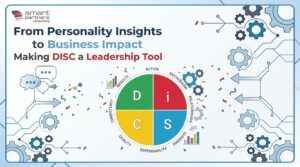
Discover how Everything DiSC® helps leaders improve communication, strengthen teamwork, and translate behavioural insights into better business outcomes. Why Understanding
On 16th September, 2026, Smart Partners Consulting Limited, a foremost and indigenous management consulting firm in Nigeria, hosted a timely