Compare ERP and traditional business management and see how InvexERP helps African businesses streamline operations, automate workflows, and make smarter decisions.
Understanding the Difference Between ERP and Traditional Business Management
Running a business involves managing several moving parts. Think of finance, sales, inventory, procurement, human resources, payroll, and customer relationships. Managing all of these functions isn’t the problem. The challenge is ensuring they work together efficiently.
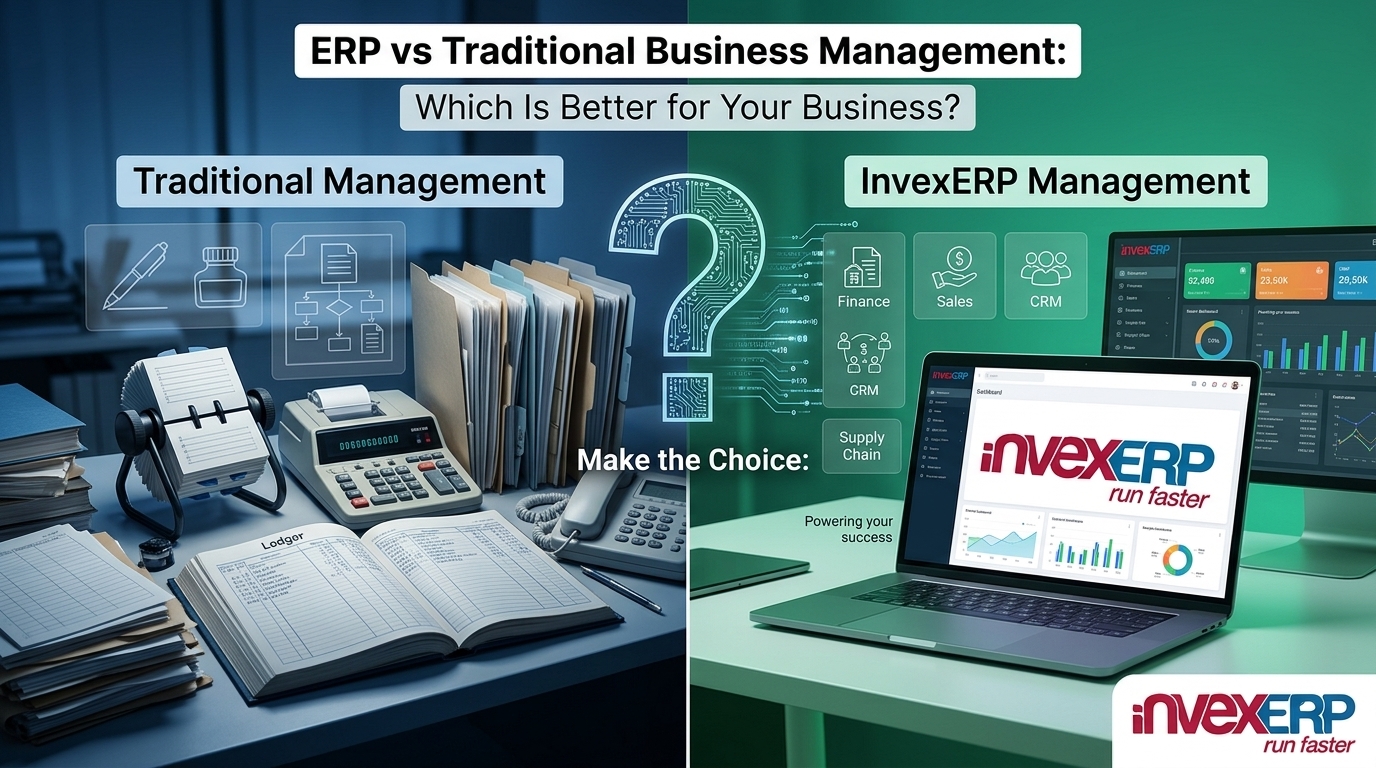
With traditional business management, different departments often rely on separate spreadsheets, manual records, disconnected applications, or independent processes. While this approach may work for a small operation initially, it can become increasingly difficult to manage as the business grows.
Another downside of traditional business management is that reports take longer to compile. Information may be inconsistent across departments, approvals can be delayed, and management may struggle to get a clear picture of business performance.
To solve this challenge, you need an Enterprise Resource Planning (ERP) system. An ERP system like InvexERP connects core business functions on a unified platform. This allows departments to share information, automate processes, and access reports more efficiently.
InvexERP Vs. Traditional Business Management: Key Differences
Feature
InvexERP
Traditional Business Management
Data and operations
Connects key functions, including finance, sales, HR, procurement, and inventory, on one platform.
Information may be scattered across spreadsheets, separate software, and manual records.
Reporting and decisions
Provides dashboards, real-time reports, and AI assistance through Naila AI.
Reporting often requires manually gathering and reconciling information from different sources.
Workflows and approvals
Automates configured workflows and tracks approval histories and user activities.
Requests and approvals may depend on emails, paper forms, or manual follow-ups.
Why Traditional Business Management Can Hold Your Business Back
The biggest limitation of disconnected business processes is the time and effort required to keep everything aligned. Some of the limitations are:
1. Time-consuming operations: Repeated data entry, manual reconciliations, and follow-ups consume time that employees could spend on higher-value activities.
2. Limited business visibility: When departments maintain separate records, management may find it difficult to obtain timely, consistent information about cash flow, stock levels, sales, or workforce performance.
3. Greater risk of errors: Manual processes and duplicate records can increase the risk of inconsistencies, missed approvals, and reporting mistakes.
4. Difficulties scaling: As transactions, employees, and business locations increase, processes that once seemed manageable can become harder to coordinate and control.
These challenges do not mean traditional methods are always ineffective. They mean businesses need to assess whether their current systems can support their operational complexity and growth ambitions.
How InvexERP Helps Businesses Operate More Efficiently
InvexERP brings essential business functions together through an integrated cloud platform. Its capabilities include finance and accounting, sales and invoicing, customer relationship management, procurement, inventory and warehouse management, HR and payroll, project management, and business intelligence.
Its built-in AI assistant, Naila AI, can help users generate and analyse reports, review financial and sales performance, monitor inventory activities, and automate repetitive administrative tasks using natural-language instructions.
For example, a retail and distribution company can use connected inventory and procurement processes to improve stock visibility. A manufacturing business can also connect finance, procurement, inventory, and operational activities more effectively.
InvexERP can also support businesses across sectors such as healthcare, logistics, construction, agriculture, energy, and food and beverage. Its modular structure lets organisations choose the capabilities they need and expand as they grow.
Is It Time to Move from Traditional Management to ERP?
If your team spends too much time preparing reports, reconciling records, tracking approvals, or searching for information across departments, it may be time to consider an integrated ERP solution.
The goal is not simply to adopt new software. It is to create more connected processes, strengthen accountability, improve visibility, and give decision-makers better information to guide business performance.
Book an InvexERP Demo with Smart Partners Consulting
See how InvexERP can work for your business. Book your demo today with Smart Partners Consulting Limited to explore practical use cases for your industry and discover how a more connected approach to business management can help your organisation work smarter and prepare for sustainable growth.
Compare ERP and traditional business management and see how InvexERP helps African businesses streamline operations, automate workflows, and make smarter