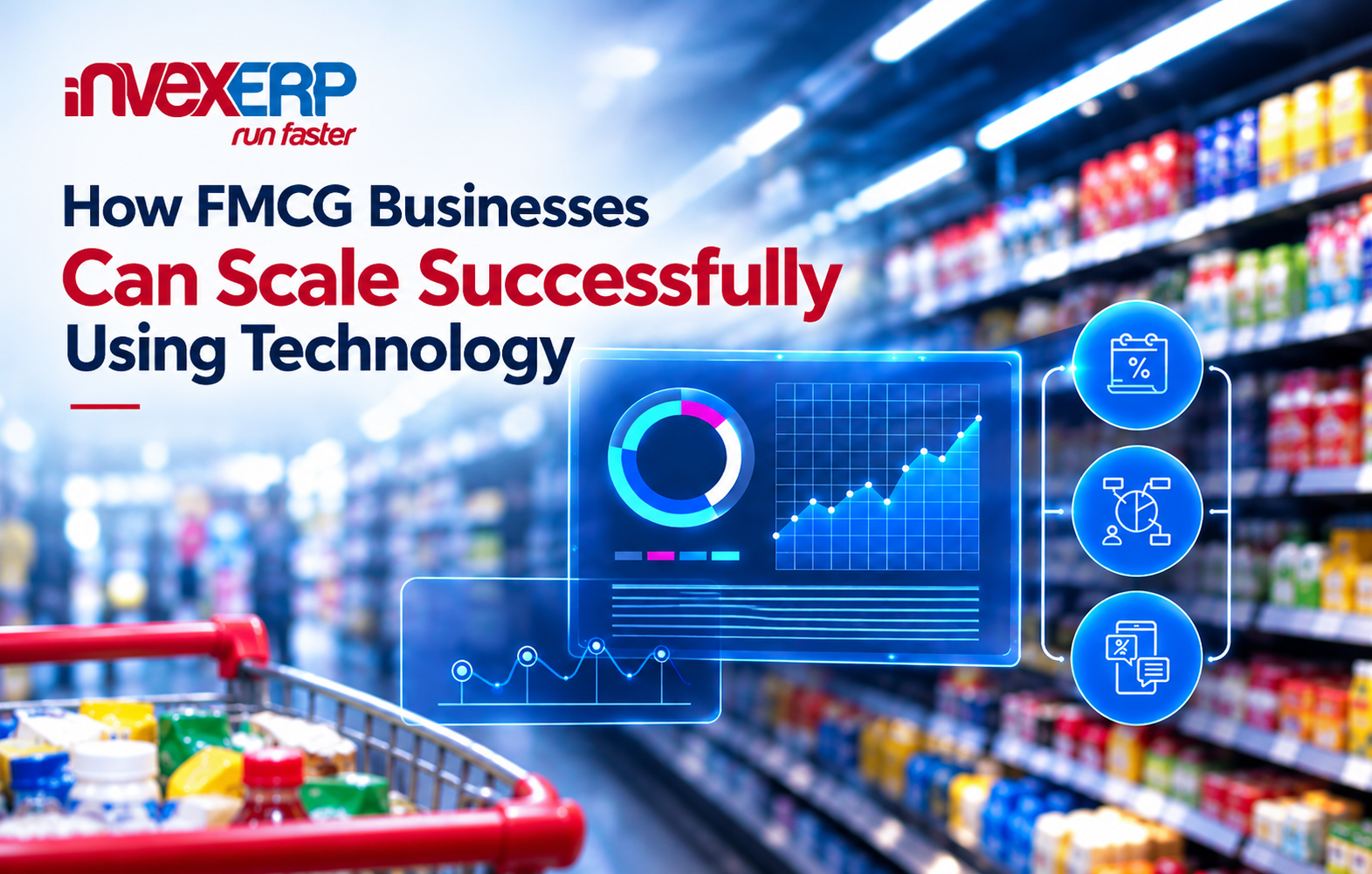
The ever-evolving fast-moving consumer goods and retail industries demand an agile workforce, efficient processes, and real-time visibility to keep pace with changing consumer trends.
As businesses expand into new markets, add products, increase distribution channels, and serve more customers, operational complexity grows.
A major challenge FMCG businesses encounter is that scaling revenue is easier than scaling operations. A company X can increase sales while simultaneously experiencing inventory problems, delayed approvals, and inefficient distribution. They can also experience poor field-sales visibility, fragmented data, and rising operating costs.
Sustainable growth therefore requires more than selling more products. It requires building an operating system capable of handling greater volume without creating proportional increases in cost and complexity.
To solve this challenge, businesses need an Enterprise Resource Planning system like InvexERP.
What Does It Mean to Scale an FMCG Business?
Scaling an FMCG business means increasing revenue, market presence, distribution capacity, and operational output without a proportional increase in costs or inefficiencies.
For an FMCG company, this can involve expanding into new territories, increasing production, onboarding more distributors, managing larger inventories, or growing its field sales team.
However, every layer of growth introduces more transactions and more data. Without integrated systems, businesses often respond by adding more people, spreadsheets, manual processes, and meetings. Eventually, this creates a new set of problems rather than growth.
5 Ways Technology Can Help FMCG Businesses Scale
1. Integrate Your Business Operations
Growth becomes difficult when finance, sales, procurement, inventory, distribution, and other departments operate from disconnected systems.
An ERP system connects critical business processes and allows decision-makers to see what is happening across the organization. Instead of asking different departments for separate reports, management can access consolidated information and make decisions from the same data.
2. Take Control of Inventory
Inventory is one of the biggest operational challenges for FMCG businesses. Too much stock ties up working capital and increases the risk of expiry, damage, and obsolescence.
On the other hand, too little stock leads to stockouts, missed sales, and dissatisfied customers. But when you leverage technology, it can provide real-time visibility into inventory levels, product movements, slow-moving products, and replenishment requirements.
3. Improve Sales and Distribution Visibility
As an FMCG business expands its territory, managing distributors, sales representatives, orders, and deliveries manually becomes increasingly difficult.
Technology can connect sales orders, distribution, inventory, and finance, giving management better visibility into what is being sold, where products are moving, and where performance gaps exist. This enables faster responses to market changes instead of relying on delayed reports.
4. Automate Repetitive Processes
Scaling through manual processes is expensive. Processes like purchase approvals, invoicing, reconciliations, inventory updates, reporting, and other repetitive activities can consume valuable employee time. This can also create opportunities for human error.
Modern ERP platforms automate many routine processes while keeping data connected across departments. This can reduce manual work and give employees more time to focus on activities that require judgement and commercial expertise.
5. Turn Business Data Into Better Decisions
More business activity means more data. But unfortunately, more data does not automatically mean better decisions. The real advantage comes from converting operational data into actionable insight.
An integrated system can help management monitor sales performance, inventory, procurement, cash flow, profitability, and operational trends from a central platform. InvexERP combines real-time data with analytics and AI-assisted insights to support faster decision-making.
Technology Alone Won’t Scale Your FMCG Business
Technology is not a substitute for good processes. Before automating a process, FMCG businesses should ask:
- Is the process clearly defined?
- Where are the current bottlenecks?
- What information is required to make decisions?
- Which activities can be automated?
- Who owns each stage of the process?
Automating a broken process simply creates a faster broken process. A successful digital transformation combines process improvement, people, technology, and data.
Where Does InvexERP Fit In?
For FMCG businesses looking to scale, InvexERP can help bring critical operations into a single connected environment—from inventory and procurement to sales, finance, distribution, and reporting.
Instead of managing growth through disconnected spreadsheets and manual processes, businesses can build greater visibility, control, and efficiency into their operations.
The objective for businesses, therefore, isn’t simply to introduce another software system. It is to give their business the infrastructure to scale intelligently.
Ready to Scale Smarter?
If your FMCG business is growing but operational complexity is growing with it, the next step may not be to hire more people or add more spreadsheets. It may be connecting the systems that run your business.
Contact Smart Partners Consulting Limited to Request a Demo and see how InvexERP can help your FMCG business streamline operations, improve visibility, and build the capacity to scale. We can also deploy InvexERP for your organization and tailor the implementation around your operational needs.