
Business Growth

How Data-Driven Decision-Making Helps FMCG Companies Increase Profitability
Learn how FMCG companies can use business data to improve sales, manage inventory, reduce costs, and how InvexERP supports smarter
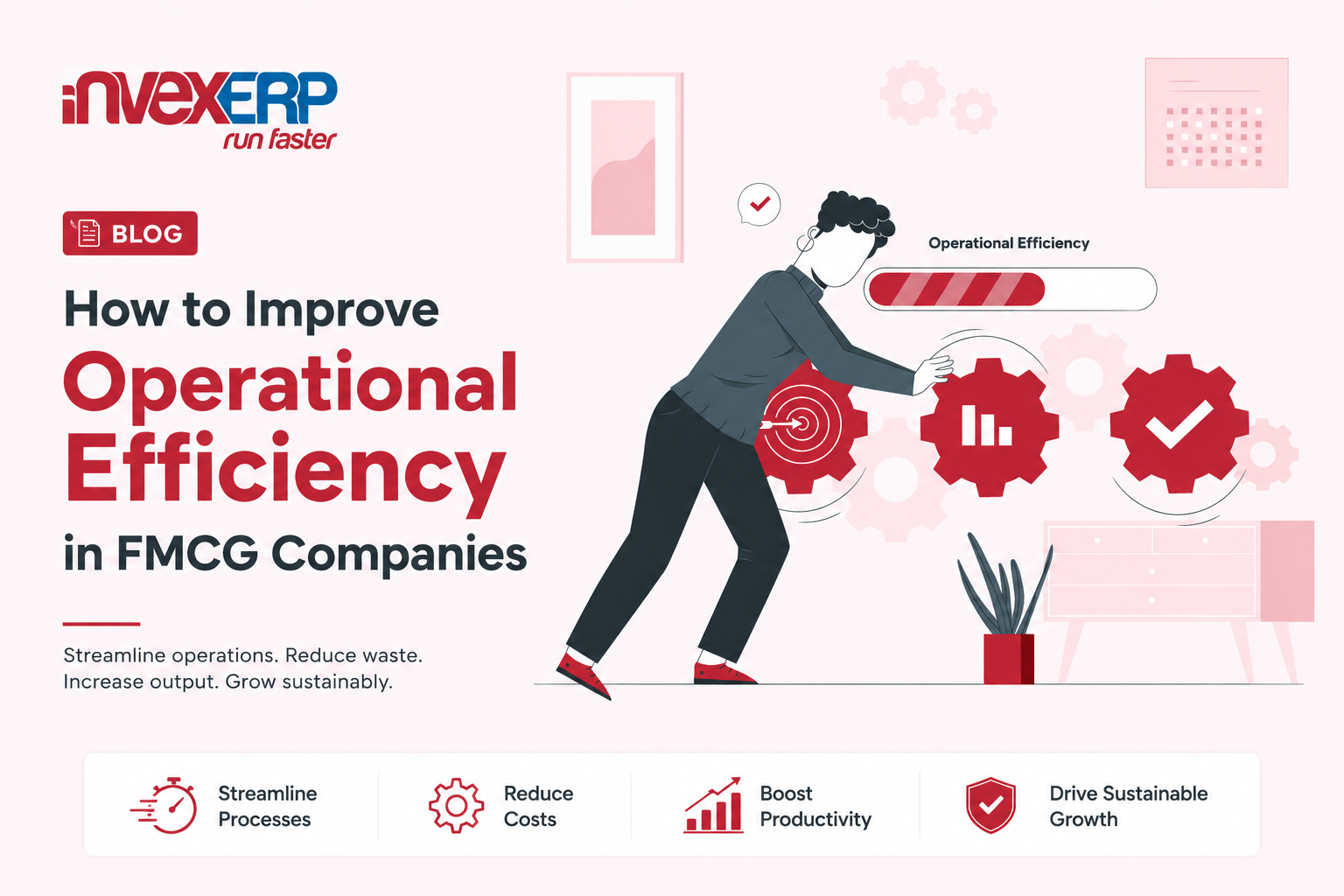
Operational efficiency used to be an operational goal for FMCG companies. But today, it has become a competitive necessity due to technological advancement.
Manufacturers are navigating a difficult business environment characterized by persistent inflation, exchange rate volatility, rising logistics costs, supply chain disruptions, and increasingly price-sensitive consumers. However, many FMCG companies are discovering that profitability is often won or lost inside their operations.
This article explores the root causes of operational inefficiency. You’ll also learn how process redesign, ERP systems, and business automation can help Nigerian FMCG companies build faster, leaner, and more profitable operations.
Operational efficiency simply means producing more value while using fewer resources. As consumers are becoming more price-conscious, raw material costs continue to fluctuate, and businesses are expected to deliver products faster without compromising quality.
For FMCG companies, operational efficiency translates into:
This simply means that operational inefficiency is a strategic business risk, one that any FMCG businesses are always willing to mitigate.
Many operational problems are not immediately visible on financial statements. Instead, they appear as small daily delays that accumulate into significant business losses over time. Some of the most common examples include:
Typical examples include:
The point is that every delayed approval creates a ripple effect across the business.
Many FMCG companies still rely on multiple Excel files to manage inventory, procurement, production planning, and financial reporting.
As a result, different departments often work with different versions of the same data. Instead of making swift decisions, managers spend valuable time reconciling numbers.
Inventory is one of the largest investments for FMCG businesses. Without real-time visibility, companies frequently experience overstocking, stockouts, excess warehouse costs, expired products, and emergency purchases.
Automated inventory control can significantly improve operational performance and delivery reliability.
Operational efficiency suffers when departments operate independently rather than collaboratively. A typical example is when production isn’t aligned with sales.
Many executives only discover operational problems after monthly reports are prepared. By then, opportunities have already been lost. FMCG businesses require real-time operational intelligence.
When operations slow down, many organizations respond by hiring additional employees. Unfortunately, this often increases payroll without addressing the real issue.
Imagine adding more workers to a production line designed with unnecessary constraints. The process remains inefficient. The only difference is that more people are participating in the inefficiency.
Operational excellence begins with fixing such a system.
One of the biggest misconceptions about digital transformation is that software automatically solves operational problems of FMCG companies. The fact is that technology simply accelerates existing processes.
If inefficient processes are automated without redesign, organizations simply become faster at doing the wrong things. Automation should only be introduced after redesigning workflows. This approach ensures technology supports efficiency rather than complexity.
As an FMCG business, you can redesign the way your business works and increase your operational efficiency by deploying InvexERP.
Once processes have been optimized, digital transformation becomes a powerful enabler of business performance. Integrated ERP solutions like InvexERP connect critical business functions into a single system. This enables departments to work from a single source of truth.
Instead of disconnected software and spreadsheets, FMCG organizations gain integrated visibility across operations. Business automation can improve:
Automated purchase requests, supplier management, and approval workflows reduce delays and improve accountability.
Real-time inventory visibility minimizes stockouts, reduces excess inventory, and improves production planning.
Manufacturers can schedule production more accurately based on actual inventory levels and customer demand.
Integrated financial reporting provides executives with faster, more accurate business insights.
Sales teams gain visibility into inventory availability, enabling them to make realistic delivery commitments.
Interactive dashboards provide leaders with real-time operational data, eliminating the need to wait for month-end reports.
Organizations that improve operational efficiency typically experience benefits such as:
Most importantly, business leaders gain confidence in the information used to make strategic decisions.
Operational efficiency is beyond reducing costs. It is about building a business that can respond faster, operate smarter, and compete more effectively in an increasingly demanding market.
The most successful FMCG companies are not necessarily those with the largest factories or the biggest workforce. They are the organizations with the clearest processes, the best operational visibility, and the ability to make informed decisions quickly.
Smart Partners Consulting Limited helps FMCG businesses improve operational efficiency through business process redesign and organizational advisory services. By integrating operations, automating workflows, and providing real-time business intelligence, we enable organizations to reduce complexity, improve efficiency, and position themselves for sustainable growth. You can request a DEMO to learn more.
Learn how FMCG companies can use business data to improve sales, manage inventory, reduce costs, and how InvexERP supports smarter
Discover how Everything DiSC® helps leaders improve communication, strengthen teamwork, and translate behavioural insights into better business outcomes. Why Understanding
On 16th September, 2026, Smart Partners Consulting Limited, a foremost and indigenous management consulting firm in Nigeria, hosted a timely
Talk to Our Experts