Most organizations measure success using familiar indicators such as revenue, profitability, market share, and growth. While these metrics are important, they often tell only part of the story.
On the surface, many businesses look successful. However, these businesses struggle with internal inefficiencies, leadership gaps, declining adaptability, talent shortages, and operational weaknesses that threaten their long-term sustainability.
This therefore raises an important question: “What makes a business truly sustainable?” The answer may lie in a very simple but powerful observation: Every thriving business is a living system.
Just as living organisms depend on multiple interconnected systems to survive and flourish, organizations require a combination of capabilities working together to achieve sustainable performance.
This thinking forms the foundation of the MR NIGER D Business Sustainability Framework. This framework is a holistic model designed to help leaders evaluate, strengthen, and sustain organizational performance.
Looking at Business Through a Different Lens
Traditional business frameworks often focus on isolated functions such as finance, operations, marketing, or human resources. However, the MR NIGER D Framework takes a broader perspective.
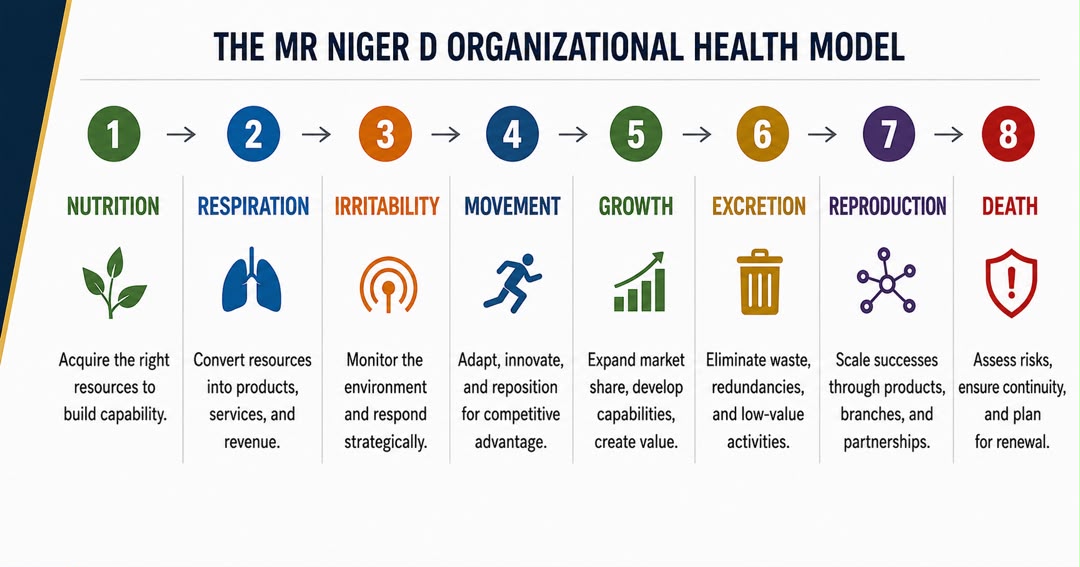
It views organizations as living systems that must continuously acquire resources, generate value, adapt to change, grow, eliminate inefficiencies, reproduce success, and manage risks. The framework consists of eight interconnected dimensions:
M – Movement
Every healthy organization must be capable of movement. In business terms, this represents agility, innovation, and the ability to adapt to changing market conditions. Organizations that lose their ability to move often struggle to remain competitive.
R – Respiration
Respiration represents revenue generation and operational efficiency. Just as oxygen sustains life, consistent revenue and efficient operations sustain business performance. Without strong revenue-generating systems, growth becomes difficult to maintain.
N – Nutrition
Living organisms require nutrients to survive just as businesses require resources. These resources include talent, technology, capital, information, and strategic partnerships. Organizations that fail to continuously replenish critical resources often experience stagnation.
I – Irritability
In biology, irritability refers to the ability to respond to stimuli. In business, it reflects an organization’s ability to sense and respond to changes in customer needs, market conditions, competition, and emerging risks. Responsiveness is increasingly becoming a competitive advantage.
G – Growth
Growth remains one of the most visible indicators of organizational success. However, sustainable growth extends beyond revenue expansion. It includes capability development, market expansion, leadership development, and increased organizational capacity.
E – Excretion
Many organizations focus heavily on acquiring resources but pay insufficient attention to eliminating waste. Excretion within the framework refers to the removal of inefficiencies, unproductive activities, outdated processes, and resource drainers.
Sustainable businesses understand that growth and efficiency must work together.
R – Reproduction
Healthy systems replicate what works. For organizations, reproduction involves scaling successful processes, developing future leaders, expanding into new markets, and transferring institutional knowledge.
It ensures that success can be repeated rather than achieved by chance.
D – Death
While often overlooked, every sustainable organization must prepare for disruption. This dimension focuses on risk management, succession planning, organizational resilience, and business continuity.
Risk in business cannot be eliminated by ignoring it. But preparing for risk strengthens a business’s long-term sustainability.
Why This Framework Matters in Today’s Business Environment
Businesses are operating in increasingly uncertain environments. Economic volatility, technological disruption, changing customer expectations, talent shortages, and evolving competitive landscapes require business leaders to think differently about sustainability.
As a result, growth alone is no longer enough. Businesses must develop the systems required to sustain that growth.
The MR NIGER D Framework provides leaders with a practical lens for assessing organizational health beyond financial performance alone.
It encourages organizations to ask critical questions:
- Are we adaptable enough?
- Are our revenue systems sustainable?
- Do we have the right talent and resources?
- How effectively do we respond to change?
- Are we eliminating inefficiencies?
- Can our success be replicated?
- Are we prepared for future risks?
The answers to these questions often determine whether an organization merely survives or achieves lasting success.
Conclusion
The sustainability of a business is a system. The businesses that thrive understand that long-term success requires more than short-term growth metrics. It requires continuous investment in organizational health.
By viewing businesses as living systems, leaders gain a more complete understanding of the factors that drive resilience, performance, and sustainable growth.
Contact Smart Partners Consulting Limited to discover how the MR NIGER D Business Sustainability Framework can help you assess critical business factors, strengthen performance, and position your organization for long-term success.